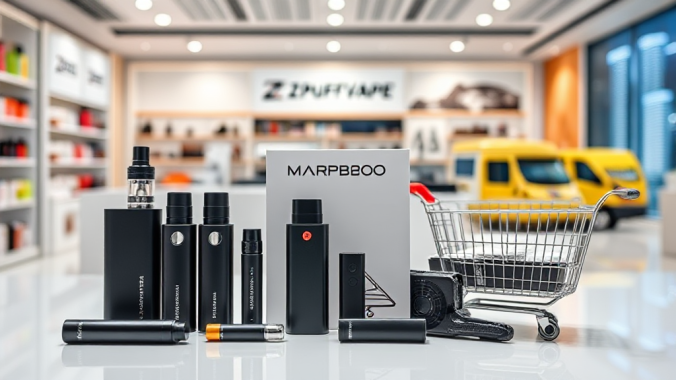
Inside the MARBO 25000 Puffs: What a 25K Capacity Actually Involves
A puff count is the visible tip of a set of engineering trade-offs. When a manufacturer prints “25,000 puffs” on a box, that number is not a single spec — it is the outcome of a negotiation between battery energy, coil resistance and longevity, and the physical volume of e-liquid the device can hold. Understanding how those three systems interact explains why a 25K disposable behaves so differently from a 9K or 12K model, and why two devices with the same advertised capacity can still deliver very different real-world experiences. Anyone comparing options in the Singapore market, including the range available through terea singapore, benefits from looking past the headline figure and into the anatomy of the device itself.
This breakdown focuses on the marbo vape 25k as a reference point, since it sits at the high-capacity end of the disposable spectrum. The same principles apply across the category, whether you are looking at a compact lana pen plus 9k or a larger lana pix 20k.
Why Puff Counts Are Really a Capacity Equation
Puff count is a marketing-friendly summary of three variables that engineers have to balance against each other: stored energy in the battery, the volume of e-liquid in the reservoir, and the rate at which the coil consumes that liquid. Increase any one of these without adjusting the others and the device either runs dry early, loses power before the liquid is gone, or produces inconsistent vapour toward the end of its life.
A 25,000-puff rating implies a substantially larger e-liquid reservoir than a 9,000-puff device — often more than double the volume. It also implies a battery with enough watt-hours to vaporise that liquid over the device’s full lifespan, not just the first few hundred puffs. The coil, meanwhile, has to survive the entire duration without degrading to the point where flavour turns harsh or output drops noticeably.
That is why a 25K device is physically larger and heavier than a 9K pen-style unit. The extra capacity has to live somewhere. Manufacturers who try to shrink the chassis too aggressively end up compromising one of the three variables, usually battery life, which is why some high-puff devices feel underpowered in their final third.
Battery Architecture and Charging Behaviour
Most 25K disposables use a rechargeable lithium-ion cell paired with a USB-C charging port, because a single-use battery large enough to vaporise that much liquid would be impractical to ship and wasteful to discard. The battery is sized so that a full charge roughly corresponds to a meaningful fraction of the device’s total puff capacity, and top-up charging is expected rather than optional.
Charging behaviour matters more than most users realise. A 25K device typically charges at a modest rate — often under 1A — to protect the cell and manage heat. Fast-charging a disposable at 2A or higher can shorten the cell’s usable life and, in some cases, trigger the device’s thermal protection before it reaches full capacity. The practical rule is to use a standard 5V/1A adapter rather than a high-wattage phone charger, and to unplug once the indicator shows full.
Battery drain is not perfectly linear. The first half of a 25K device’s life tends to hold voltage steadily, producing consistent output. As the cell approaches its lower voltage threshold, the device may reduce power to avoid a sharp drop in performance, which is why some users notice a softer hit near the end. This is normal behaviour, not a defect, and it is one of the trade-offs that separates a well-tuned 25K from a cheaper high-capacity clone.
For comparison, a smaller device like the lana ultra 2 uses a proportionally smaller cell, which is why its charging cadence feels different — more frequent top-ups, but each one shorter.
Coil Longevity: The Real Limiter on Puff Count
If battery and e-liquid are the fuel and the tank, the coil is the engine — and it is usually the component that determines whether a device actually reaches its advertised puff count. A coil that degrades early will start producing dry or burnt notes long before the liquid runs out, effectively capping the device below its rated capacity.
Mesh coil designs have become standard in high-capacity disposables because they distribute heat across a wider surface area than a traditional wire coil. That wider contact patch vaporises liquid more evenly, reduces hot spots, and generally extends usable coil life. In a 25K device, mesh construction is close to essential; a simple wire coil would struggle to survive 25,000 puffs without noticeable flavour degradation.
Coil longevity also depends on how the device is used. Long, slow draws allow the wick to re-saturate between puffs, which keeps the coil cooler and extends its life. Rapid, back-to-back draws can outpace the wicking rate, leading to partial dry hits that accelerate degradation. Chain-vaping a 25K device is the fastest way to turn a 25,000-puff rating into something closer to 15,000.
E-liquid formulation plays a role too. Higher-VG liquids tend to be thicker and wick more slowly, which can stress a coil if the device is not designed for them. Most 25K disposables are tuned for a specific VG/PG ratio, and using a dramatically different liquid — where refillable or semi-refillable designs allow it — can shorten coil life considerably.
E-Liquid Volume and the Physical Limits of Miniaturisation
E-liquid volume is the most straightforward of the three variables, but it is also the one most constrained by physics. A 25,000-puff device needs a reservoir large enough to supply the coil for the full duration, and that reservoir has to fit inside a chassis that is still meant to be pocketable. The result is a design that leans on every available millimetre.
Larger reservoirs create their own challenges. As liquid is consumed, air enters the reservoir, and the wicking system has to keep feeding the coil consistently even as the internal pressure changes. Poorly designed high-capacity devices often perform well when full and then develop weak or inconsistent draws as the liquid level drops. Good ones maintain steady wicking from first puff to last.
This is where the difference between a 25K device and a mid-capacity option like the lana pix becomes clear. The 20K device has a smaller reservoir and a correspondingly smaller battery, which makes it lighter and easier to carry but also means more frequent replacement. Neither approach is inherently better — they simply serve different usage patterns.
For users who prefer a more compact form factor, a device like the snowwolf 16k sits in the middle ground, offering a meaningful step up from entry-level capacity without the bulk of a full 25K chassis.
What the Anatomy Means for Real-World Use
Understanding the internal relationships changes how you evaluate a device. A 25K rating is not a guarantee of 25,000 identical puffs; it is a best-case figure produced under controlled draw conditions, usually a specific puff duration and interval. Real-world usage — longer draws, frequent vaping, higher ambient temperatures — will bring the effective total down.
It also changes how you maintain the device. Keeping the battery between roughly 20% and 90% rather than running it to zero repeatedly tends to preserve cell health. Storing the device away from direct heat prevents the liquid from thinning and the coil from degrading prematurely. And pacing your draws, rather than chain-vaping, is the single most effective way to get closer to the advertised capacity.
Finally, the anatomy explains why high-capacity disposables are not simply “bigger versions” of smaller ones. The engineering that goes into balancing a 25K device — the mesh coil, the regulated charging behaviour, the pressure-stable reservoir — is what separates a device that genuinely delivers its rated capacity from one that only claims it. For anyone weighing up options in Singapore, whether a marbo 25k or a more compact alternative, the smart approach is to look at the components behind the number rather than the number alone.
A puff count tells you what the manufacturer hopes the device will achieve. The battery, coil, and e-liquid volume tell you what it can actually do. Once you understand how those three systems interact, choosing between a 9K, 16K, 20K, or 25K device becomes a question of matching engineering to your own habits — not simply picking the largest number on the shelf.
Leave a Reply